


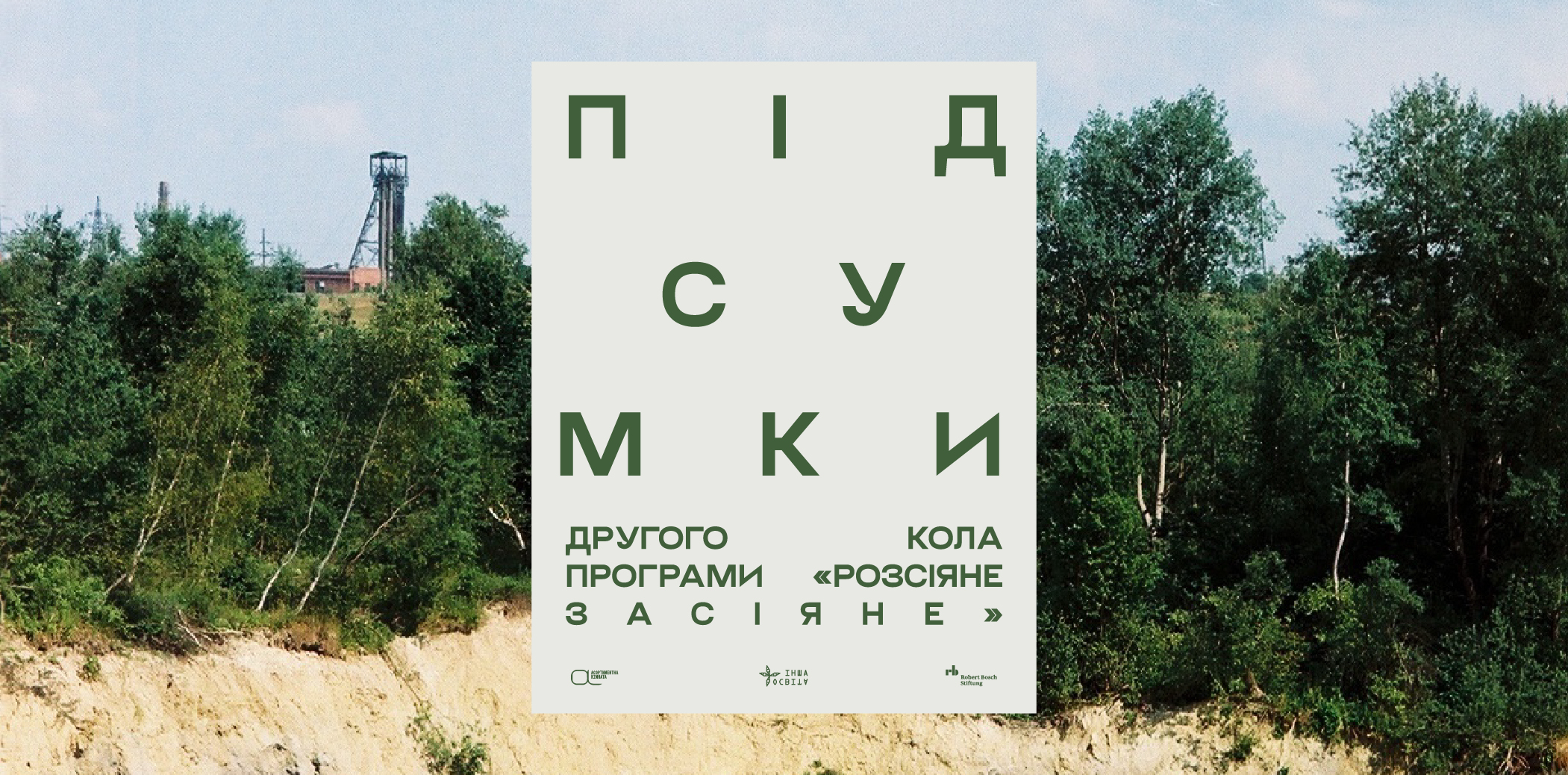
Summing up the second round of the “Scattered Communities” program
We have concluded the second round of the Scattered Communities programme, which we run together with Asortymentna Kimnata and which serves as a space for rethinking connections within the Ukrainian art community in Ukraine and abroad. Here we share how and with what we worked this year, and what came out of it.
Within the second round, we accepted applications both from individual artists and from established tandems. Those who applied individually could partner up for collaborative work with participants from both rounds. In total, we received 175 applications — from which we selected twenty artists based in Ukraine, Germany, Belgium, Austria, the Netherlands, Finland, and France.
We began with online meetings aimed at getting to know one another and searching for potential partnerships. We then moved on to discussions in a closed circle, focused on issues that are tabooed or silenced within the community. In particular, we spoke about the notion of betrayal, feelings of guilt, and ways of avoiding manipulation of the topic of war in artistic practice.
Within the second round, 9 tandems were formed, whose works and works in progress we supported. These are:
- Viktoriia Lykholiot and Mariia Petrenko — artists based in Berlin — worked on a guide to places connected to their routines in migration. In their work, they combined different media: photography, video, text, and the creation of contour maps. They have already presented the result — both online and in print.
- The “Montage Group,” consisting of Katia Libkind, Yehor Antsyhin, and Kateryna Lesiv, focused on the theme of compensatory action. The trio, scattered across different countries (Ukraine, Austria, Finland), works with shared feelings of responsibility, instability, and uncertainty — and with the possibility of balancing them through various artistic and/or everyday practices. Among what was created within their work in progress was a collective piece that migrated between the participants and was continuously supplemented in the process.
- Vitalii Matukhno (Kyiv) and Marianna Lishchynska (Leipzig) created a zine-reflection on the inequality of their personal experiences in relation to war, migration, freedom, and distance.
- Mykola Lebed and Mykhailo Tomilin — artists based in Berlin and Vienna — created the documentary animated film “Connections. Keys and Keychains. «» This is an artistic-anthropological exploration of the intersections between the functional and the decorative, and of people’s connections to spaces (internal and external).
- The family tandem of Pavlo and Danylo Kovach (Donetsk region — Vienna) explored the intersections between war and everyday life, as well as the documentary nature of artifacts as testimonies to trauma. The result of the research was the work Threshold: a multimedia installation in which a video of Pavlo washing an evacuation vehicle of blood and other fluids is projected onto a construction made of doormats, usually placed at the thresholds of homes. Danylo exchanged these mats for new ones with Ukrainian migrants in Vienna. The work became part of the exhibition “Where Is All Goes”, which Asortymentna Kimnata produced in September together with the German institution Pochen. The artists also spoke in more detail about the work in a joint interview.
- Harry Kraevets (Germany), Teta Tsybulnyk (USA), and Pavlo Kerestei (United Kingdom) conducted a series of psychotherapeutic walks titled In Search of Antarctica. Anchored in the concept of Antarctica as a shared land, they began simultaneously in Germany, Ukraine, and the UK, moving along a common vector. In these walks, the collective combined practices of reading aloud, performative actions, exploration of spaces and suburban environments, as well as elements of group psychotherapeutic processes.
- Artists Valeriia Zubatenko and Kateryna Motylova, who live in Brussels and The Hague, created the Encyclopedia of Catastrophe. It became a continuation of Valeriia’s broader project Museum of the Apocalypse. The encyclopedia is presented as a temporary museum exhibition dedicated to human–environment interaction in the post-industrial world. The field of research was the Ukrainian city of Zaporizhzhia.
- Volodymyr Prylutskiy (Kyiv), Pavlo Yurov (front line), and Anna Ivchenko (Berlin) explored processes of long-term communication through correspondence practices. Their intention was to render visible “Ukrainian multiverses” — the (in)accessible spaces of experience of Ukrainians in emigration, in the rear, and at the front. The exchange of correspondence grew into an interdisciplinary process involving various media: text, video, sound, photography, and performative actions.
- Vitalii Ruppelt (Rivne/front line) and Mykola Lebed (Vienna) created the sound installation “Oneness”. Both artists work with sound, grew up in Rivne, and in this work — built on an exchange of field recordings — explored differences in experience and in the conditions in which they find themselves. The work was presented in August 2025 at the exhibition Do They Sing?, which became part of the broader project Do Frogs Sing in Walls, built on collaboration between artists who serve in the military and their colleagues from civilian contexts. In November, a presentation of curatorial approaches focused on this program took place at the University of Applied Arts Vienna (Die Angewandte), where Mykola Lebed also presented “Oneness”. We thank Office Ukraine for the invitation!
The work on both cycles of “Scattered Communities” also resulted in a book of essays written by the participants. It will be published by the publishing project ilostmylibrary.
A separate form of communication between participants is the mobility program within “Scattered Communities”. It provided two participants with opportunities to return to Ukraine after prolonged migration. Pavlo Kerestei, who hosted colleagues in Reading (England) during the first round, visited his native Uzhhorod, as well as Lviv and Kyiv. Marianna Lishchynska, currently based in Vienna, visited Rivne and Kyiv. In addition, Iryna Loskot made use of the mobility program, visiting Kateryna Motylova in The Hague and Harry Kraevets in Berlin to plan joint artistic projects. Danylo Kovach also visited Kateryna Berlova in Berlin.
An integral part of the program is artist talks by participants. In this cycle, we held three:
- “Zaporizhzhia: Marginalised Artistic Practices and Art Beyond Galleries” by Mykhailo Tomilin and Valeriia Zubatenko.
- “The Hideout Ahead. On Burroughs’ Chernihiv Portrait, Boundlessness, and Crossing Borders” — a conversation between Mykola Karabinovych and Dmytro Kurovskyi, an artist, musician, and founder of the underground project Foa Hoka.
- “Mistake as a Method” — a conversation between Kateryna Berlova and Yaroslav Futymskyi.
At present, we remain in contact with all participants and observe how their projects continue to develop. Despite the formal completion of the second cycle, we continue the polylogue that began together with the program. What comes out of it next — we will definitely share.
The Scattered Communities program is implemented by Asortymentna Kimnata and Insha Osvita with the support of the Robert Bosch Stiftung.

